
Circular agriculture: returning nutrients to the soil and value to farming systems
Regenerative agriculture is often associated with practices that aim to improve soil health, water cycles, biodiversity and landscape function. This may include maintaining groundcover, reducing soil disturbance, integrating livestock, increasing plant diversity and rebuilding soil organic matter.
There is no single definition or prescribed set of practices for regenerative agriculture, but these approaches share a common ambition: to improve the function of the farming system rather than focus solely on the next crop or production cycle.
Circular agriculture brings another important dimension to that ambition.
According to the United Nations Food and Agriculture Organisation (FAO), circular agriculture “focuses on minimising external inputs, closing nutrient loops, regenerating soils, and minimising environmental impacts”. As a result, it asks how resources already moving through our food and agricultural systems - including nutrients, organic matter and water - can be recovered and returned to productive use rather than treated as waste.
For Australia, that creates a significant opportunity. Agricultural production removes nutrients from the soil, while valuable nutrient resources generated elsewhere in the food system are often lost, underused or sent to landfill. Carefully managed biosolids can help reconnect those two ends of the cycle.
From a linear system to a circular one
Modern food production generally follows a largely linear path. Nutrients are extracted or manufactured, applied to agricultural land, incorporated into crops and livestock, transported into towns and cities through food, and eventually enter landfill or wastewater treatment systems.
Traditionally, the residual materials produced by those systems have been viewed primarily as a disposal problem. Yet treated biosolids can contain nutrients and organic matter with potential value for suitable agricultural soils.
Circular agriculture seeks to retain that value within the system:
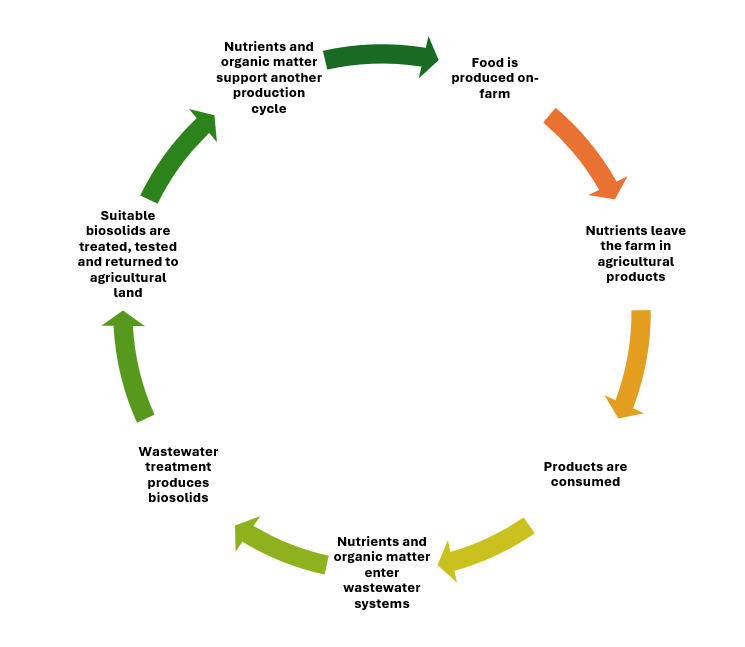
Food is produced on farms.
Nutrients leave the farm in agricultural products.
Those products are consumed.
Nutrients and organic matter enter wastewater systems.
Wastewater treatment produces biosolids.
Suitable biosolids are tested, managed and returned to agricultural land.
Their nutrients and organic matter support another production cycle.
This does not create a completely closed loop. Nutrient losses still occur, and recycled inputs cannot meet every soil or crop requirement, but it can reduce unnecessary waste and keep existing resources working for longer.
Where circular and regenerative agriculture meet
It’s important to recognise that circular and regenerative agriculture are not interchangeable concepts.
Circular agriculture focuses on recovering and reusing resources. Regenerative agriculture focuses more broadly on improving soil health, ecological function and the resilience of farming systems. Their objectives overlap when recycled nutrients are used in ways that support better soil performance, and that distinction is important.
Applying a recycled nutrient product does not automatically make a farming system regenerative. The value of any input depends on what the soil needs, how the material is managed and how it fits within the wider farming system.
Used appropriately, biosolids can complement regenerative practices by contributing:
plant nutrients that support pasture or crop production
organic matter that may help improve soil condition
a broader range of nutrients than fertiliser programs that are focused primarily on nitrogen, phosphorus and potassium
an opportunity to reduce reliance on synthetic or externally sourced inputs
a productive use for material that might otherwise be treated as waste.
The goal is not simply to replace one input with another. It is to combine nutrient reuse with soil testing, responsible application, groundcover management, erosion control and other practices that keep nutrients cycling within the landscape.
Healthy soil is more than a store of nutrients
Soil is not just a medium for holding applied fertiliser. It is a living system whose physical, chemical and biological characteristics influence how effectively plants can access nutrients and water.
A soil may contain nutrients but still perform poorly if its structure restricts root development, its pH limits nutrient availability or its organic matter and biological function have declined.
That is why the growing interest in regenerative agriculture is so relevant to nutrient management. It encourages producers and the wider agricultural sector to look beyond the quantity of nutrients applied, and consider how effectively the soil can retain, cycle and use them.
Recent reporting has also explored whether farming practices that improve soil health may contribute to more nutrient-dense food.
Some emerging studies from the UK have identified positive relationships, but the evidence remains variable, and researchers have not established that regenerative production will consistently deliver higher nutrient density across different crops, soils and farming systems. The more defensible conclusion is that soil health matters - and that rebuilding soil function may deliver benefits extending beyond the immediate fertiliser response.
The Guardian provides a useful overview of the emerging research and its limitations here.
Biosolids are one part of the system
Biosolids should not be treated as a universal solution or applied simply because they are available. Their suitability depends on factors including:
the characteristics and nutrient requirements of the receiving soil
the quality and classification of the biosolids
crop or pasture requirements
landform, drainage and erosion risk
application rates and timing
regulatory requirements
practical considerations such as transport, storage and application
ongoing monitoring and record-keeping.
This is why every well-designed biosolids project should begin with the soil.
Testing establishes existing nutrient levels and identifies constraints that may affect both productivity and environmental risk. Biosolids analysis can then be considered alongside the receiving soil to enable application rates and management controls to be tailored to the site.
This moves biosolids management away from a waste-disposal mindset and towards nutrient stewardship.
Nature-based solutions must work with natural systems
Returning suitable organic resources to the land is an example of how nature-based systems thinking can inform infrastructure and resource-management decisions.
Instead of relying solely on linear systems that extract resources, use them once and dispose of the residuals, nature-based systems solutions look for opportunities to work with biological cycles.
In agriculture, that means recognising that nutrients, organic matter, water, vegetation and soil biology are connected. Improving one part of the system without considering the others can limit the outcome or create unintended risks.
For example, adding nutrients to a poorly structured or erosion-prone soil will not necessarily improve long-term performance. Some of those nutrients may remain unavailable to plants or be lost from the paddock.
A more integrated approach may combine:
soil assessment and targeted nutrient application
recycled organics where suitable
maintenance of living roots and groundcover
reduced erosion and runoff
improved water infiltration and retention
crop or pasture diversity
monitoring of soil and production outcomes.
This is where circular nutrient use can become more than a waste-management exercise. It can support a wider transition towards farming systems that retain more of their resources and build resilience over time.
Making circular agriculture credible
Circularity is not achieved simply by moving material from an urban facility to a farm.
A credible circular agriculture model must demonstrate that the material is suitable, that it meets regulatory requirements and that its application addresses a genuine agronomic need without creating unacceptable risks.
It also needs to work for the people at both ends of the system.
For utilities and resource managers, responsible agricultural reuse can provide a productive pathway for an unavoidable organic resource.
For farmers, it may provide access to nutrients and organic matter that support soil improvement and agricultural productivity.
For the wider community, it can reduce waste, improve resource efficiency and create stronger connections between urban consumption and regional production.
Realising those benefits requires science, planning, transparent communication and long-term stewardship.
Building a more circular nutrient future
Australia will continue to use conventional fertilisers. Circular agriculture is not necessarily an argument for eliminating them entirely, nor is the use of biosolids alone enough to regenerate a farming system.
The opportunity is to use all available nutrient resources more intelligently. That means matching inputs to soil and crop needs, recovering value from suitable organic resources, reducing avoidable nutrient losses and supporting practices that improve the soil’s capacity to function.
BYV Organics brings together specialist experience in biosolids management, agricultural delivery and soil science to develop safe, compliant and beneficial reuse programs. Working with Verterra Ecological Engineering, we start with the soil - assessing its condition and nutrient requirements before determining how biosolids can be incorporated into a tailored land application program.
Because a genuinely circular system does more than divert material from disposal. It returns nutrients to productive use, supports healthier soils and creates value across the entire food and resource cycle.